Showing posts with label fruits. Show all posts

Tuesday, August 16, 2016

Philippines fruits


TOP 10 Tropical and Exotic Fruits of the Philippines


The tropical climate of the Philippines makes it possible for the soil to grow some delicious exotic fruits. Most of these exotic fruits are of South American origin and brought here by the West Indies, Spanish or the Americans. These heavenly fruits can be found fresh in the local market for cheap prices. Some of the fruits mentioned are only available seasonally.


    top10philippines.blogspot.com

  1. Philippine Mangoes
  2. - undeniably Philippine mangoes are the sweetest and juiciest in the world. Recorded in the 1995 World Guinness Book of Records as the sweetest fruit. The sweetest mangoes come from the province of Zambales and Guimaras in IloIlo.

    There is a wide variety of mangoes in the Philippines but the most popular and the sweetest is the "Kalabaw" variety. Locals eat unripe green mangoes with bagoong (shrimp paste) although this maybe an usually acquired taste. Green mangoes are great with vodka as cocktails!


    top10philippines.blogspot.com
  3. Rambutan - sweet and juicy when fresh. Rambutan literally means hairy caused by the 'hair' that covers this fruit.


    top10philippines.blogspot.com
  4. Avocado - very refreshing as fruit shake. Try if you can find avocado flavored ice-cream in the local groceries. Arce is a good brand of local ice cream. They use local fruits as flavor. Avocado is cheap in the Philippines. You can buy them at 1$USD for a kilo and when in season they can go as low as .50$USD per kilo!


    top10philippines.blogspot.com
  5. Lanzones - sweet and succulent little round fruits. The sweetest lanzones come from the province of Camiguin, where they hold an annual festival celebrating the lanzones fruit.


  6. Photobucket
  7. Durian - the king of Tropical fruits found it's way in the Philippines through our neighboring countries. Known for its large size and unique aroma. Some people regard the durian as fragrant; others find the aroma overpowering and offensive. The 19th-century British naturalist Alfred Russel Wallace famously described its flesh as "a rich custard highly flavoured with almonds"The province of Davao in Mindanao is home to durian farms.


    top10philippines.blogspot.com
  8. Langka (Jackfruit) - when ripe this fruit is very sweet and has a very aromatic flavor. It also widely used as cooking ingredient for local desserts such as ginataan and turon.


    top10philippines.blogspot.com
  9. Atis (Sugar Apple) - very sweet and creamy. It's a little bit of effort to eat this fruit as they have a lot of seeds. The fruit flesh is sweet, white to light yellow, and resembles and tastes like custard. The edible portion coats the seeds generously; a bit like the gooey portion of a tomato seed. Sugar-apple has a very distinct, sweet-smelling fragrance


    Photobucket
  10. Chico (Sapodilla) - It's aroma can be compared to beer but don't let it fool you for it is tasty. The flavor is exceptionally sweet with what can be described as a malty flavor.Originally known to have come from the West Indies


    top10philippines.blogspot.com
  11. Watermelon (Pakwan) - though widely available in many parts of the world nothing beats the refreshing taste of a succulent, sweet and juicy watermelon in the summer months.


    mangoes
  12. Santol (Wild Mangosteen) - available during the summer season. The taste is sweet and sour. The bigger variety called "Bangkok" is sweeter, the smaller variety is on the sour end. It is also used as souring agent for some Filipino dishes like sinigang.


MORE EXOTIC FRUITS FROM THE PHILIPPINES....

Photobucket
Kaimito (Star Apple)


Photobucket
Duhat (Java Plum)


Photobucket
Guyabano (Soursop)


Photobucket
Balimbing (Star Fruit)


Photobucket
Chesa (Lucuma) It has the texture of squash or the yolk of a boiled egg.


Photobucket
Aratiles (Jamaica Cherry, Muntingia) These cherries are very sweet. The sweetness brings with it an excellent taste, because it has a lovely fragrance that makes people keep on eating them. These cherries are often eaten by children because they taste quite like cotton candy.


Photobucket
Sinigwelas (Spanish Plum) It does taste like plum but it has less flesh and more seed.

Monday, August 15, 2016

Genipapo

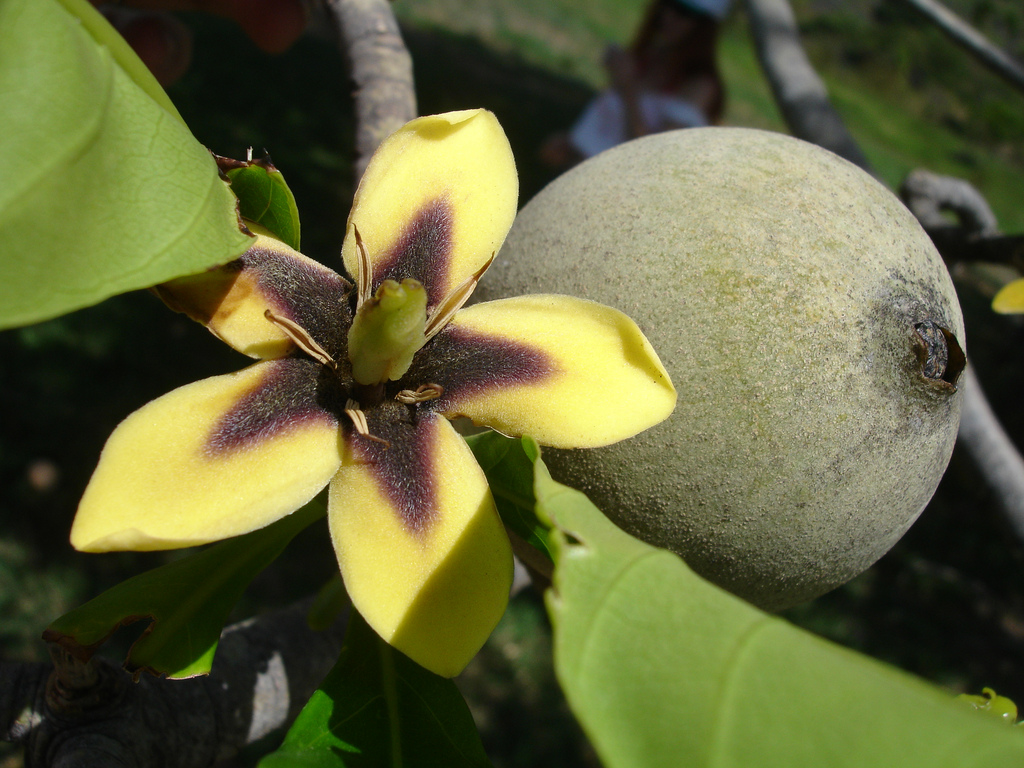
Genipapo /Genip/Genipa americana

The Hair Dye You Can Eat
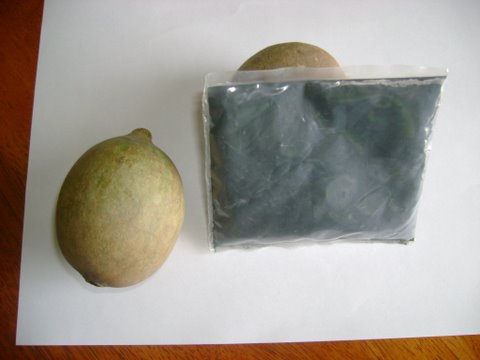
Huito fruit grows across the Caribbean and all the way down to Peru. When ripe, it’s popular as a flavor for preserves and ice cream, but when it’s still green the geniposidic acid it contains makes a tenacious dye when it oxidizes, dyeing anything it touches a rich blue-black. It’s popular for both temporary tattoos and hair color, and it makes a gentle alternative to henna or indigo. So if you’re looking for lush black hair color without chemical dyes, pop by your specialty grocery and see if they have any Huito. If you can’t find the fruit but want to try the dye anyway, you can also buy huito extract (it’s sometimes also called jagua) in many health food stores.
The genipap is native to wet or moist areas of Cuba, Hispaniola, Puerto Rico, the Virgin Islands, and from Guadeloupe to Trinidad; also from southern Mexico to Panama, and from Colombia and Venezuela to Peru, Bolivia and Argentina. Its usefulness to the Indians was reported by several European writers in Brazil in the 16th Century. It is widely cultivated in dooryards as an ornamental tree and for its fruits, but PatiƱo stated in 1967 that it was no longer as commonly grown in the Cauca Valley of Colombia as it had been in the past. The tree first fruited in the Philippines in 1913 and is occasionally planted there. Otherwise, it is virtually unknown in the Old World. Burkill wrote that it had been tried in the southern part of the Malay Peninsula several times but without success. It is reported in Brazil that there are varieties that bear all year. There is a shrubby form, jenipaporana, or jenipapo-bravo, no more than 10 to 13 ft (3-4 m) high, that grows in swamps along the edges of rivers and lakes in Brazil. The fruit is small and inedible.
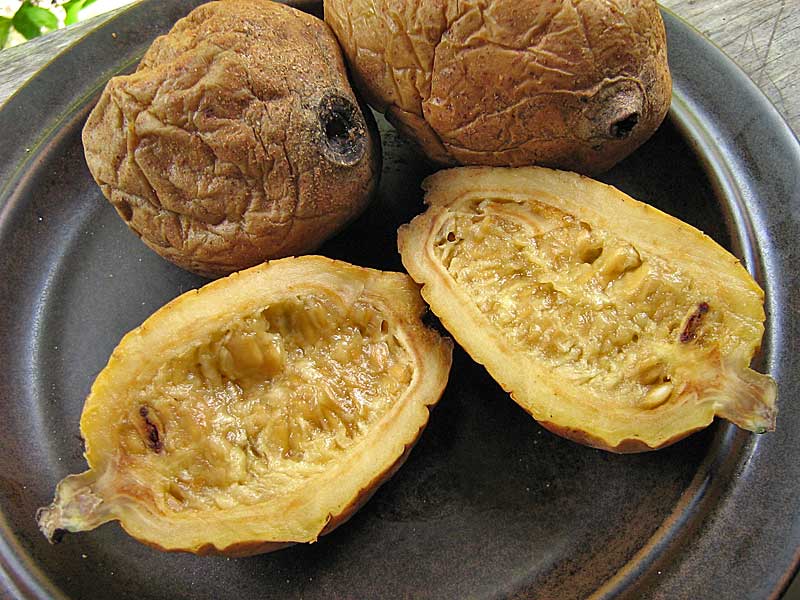
Genipap is a small to medium-sized tropical tree. It is 8 to 20 m tall, but specimens of up to 30 meters are also found. The diameter of the trunk is 30 to 80 cm and it has thick, smooth bark. It has a dense crown and the lower branches grow more or less horizontal, with 10 to 35 cm leaves at the ends. In most of Amazon Basin the trees flower in May to September and give fruit between September and April. It takes up to one year for the fruits to mature. In most trees, bees pollinate the flowers. Its fruit is a large, rounded berry, which is 9 to 15 cm long, 7 to 9 cm wide, weighing between 200 and 400 g. It has a thin and leathery covering and a 1 to 2 cm thick layer of soft, yellow-brown pulp. The central cavity contains up to 300 seeds, enclosed in membranes. The fruit is edible only when overripe and soft to the touch, when the flavor (acid to subacid) resembles that of dried apples or quinces.
In Puerto Rico, the fruit is cut up and put in a pitcher of water with sugar added to make a summer drink like lemonade. Sometimes it is allowed to ferment slightly. A bottled concentrate is served with shaved ice by street vendors. In the Philippines, also, the fruit is used to make cool drinks, as well as jelly, sherbet and ice cream. The flesh is sometimes added as a substitute for commercial pectin to aid the jelling of low-pectin fruit juices. Rural Brazilians prepare sweet preserves, sirup, a soft drink, genipapada, wine, and a potent liqueur from the fruits. Analyses made in the Philippines many years ago show the following values for the edible portion (70%) of the fruit: protein, 0.51%; carbohydrates, 11.21%; sugar, 4.30%; ash, 0.20%; malic acid, 0.63%.
The fruit is eaten as a remedy for jaundice in El Salvador. Ingested in quantity, it is said to act as a vermifuge. The fruit juice is given as a diuretic. It is a common practice in Puerto Rico to cut up the fruits, steep them in water until there is a little fermentation, then add flavoring and drink the infusion as a cold remedy. The crushed green fruit and the bark decoction are applied on venereal sores and pharyngitis. The root decoction is a strong purgative. The seeds are crushed and added to water and taken as an emetic in Brazil. When cut, the bark exudes a whitish, sweetish gum which is diluted and used as an eyewash and is claimed to alleviate corneal opacities. The juice expressed from the leaves is commonly given as a febrifuge in Central America. The flower decoction is taken as a tonic and febrifuge.
Pepperidge Farm, which, for seven years, had used artificial colorants in its colored goldfish, switched to natural dyes in July 2010. The colored goldfish are now brightened with Huito juice concentrate, annatto extract, beet juice concentrate, paprika extract, paprika, turmeric extract, and watermelon juice concentrate, instead of blue 2, red 40, red 3 and blue 1. (There is a banner on the new bags with “Colors From Natural Ingredients” written.)